
How smart hardware choices keep digital signage projects moving forward
Discover how IT teams are avoiding costly signage delays by pairing the right CMS with purpose-built media players—without ripping and replacing existing displays

Digital signage projects don't usually stall because of bad content strategy. They are frequently delayed because of hardware. Legacy media players that won't run a modern content management system (CMS), supply chain delays, ballooning budgets, and IT teams suddenly expected to become signage experts—these are the friction points that push deployments from “next week” to "maybe next year."
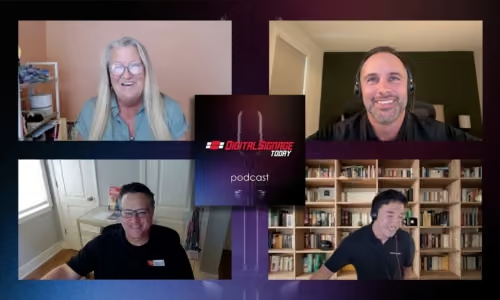
That was the central theme of a recent Digital Signage Today podcast featuring leaders from Carousel and our Amazon Signage team. The conversation was a practical, ground-level look at what actually holds digital signage projects back—and how to move them forward without starting over.
Defining your digital signage roadmap
Chris Brama, SVP of Partnerships & Channels at Carousel, framed the challenge clearly: IT teams are either scoping digital signage from scratch or inheriting a legacy system and being asked to create a standard on top of it. Neither scenario is simple, and today's logistics constraints with securing readily available hardware make both harder.
John Caswell, Carousel's Director of Sales, put it in more human terms: half the IT leaders he met didn't plan to become digital signage experts. They drew the short straw in a meeting. What they need isn't a lecture on technology — it's clarity on two questions: What do we have now, and what are we actually trying to communicate?
The answer to that second question of addressing business objectives drives everything else, including hardware decisions.
Don't overspec the digital signage hardware
Alex Gu, Executive Business Development Manager for Amazon Signage, made a point worth dwelling on: most digital signage use cases are relatively simple; yet, organizations routinely overpay for overly complex hardware that exceeds their actual needs.
That was the core insight behind the design of the Amazon Signage Stick. Purpose-built to simplify digital signage based on Amazon’s experience to modernize communications across its own facilities—physical stores, corporate offices, break rooms. Today, this offers organizations of all sizes a powerful, yet affordable professional media player to support their digital signage needs at scale.
A real-world example–150 displays, on-time, on-budget
Carousel used a customer story to reinforce the insights shared above. An auto dealership group with 150 displays across its footprint had brought Carousel in early. Mid-project, the team discovered that half the deployed displays—all system-on-a-chip (SoC) smart screens—couldn't support a modern CMS. The client was suddenly looking at an unexpected budget increase to refresh half their screens.
The solution was pairing the Amazon Signage Stick with Carousel for those displays. With the Amazon Signage Stick being easily accessible - and cost-effective - the dealership stayed on budget, deployed on time, and maintained a consistent publishing workflow across all 150 screens. Staff didn't have to learn a new interface. The project didn't slip to the following year.
It's a straightforward example, but straightforward is often what IT leaders need to see–a defined problem, a specific solution, and a solution effectively deployed.
A more flexible hardware strategy
The broader takeaway from the conversation is that enterprises don't have to choose a single hardware path. A digital signage CMS that runs across multiple device types gives IT teams room to work—centralizing control over legacy systems while they figure out a longer-term hardware standard, and mixing device types where it makes sense rather than forcing uniformity.
Supply chain pressure and market unpredictability aren't going away. Building a hardware strategy with some flexibility—and choosing partners with demonstrated supply chain reliability—is less about hedging and more about keeping projects moving. This is where Amazon excels as a recognized global leader with having the right product available when and where it is needed.
Hear the full conversation—including more on navigating supply chain challenges, managing legacy infrastructure, and what to evaluate when choosing between hardware options—in the complete podcast below.
Resources
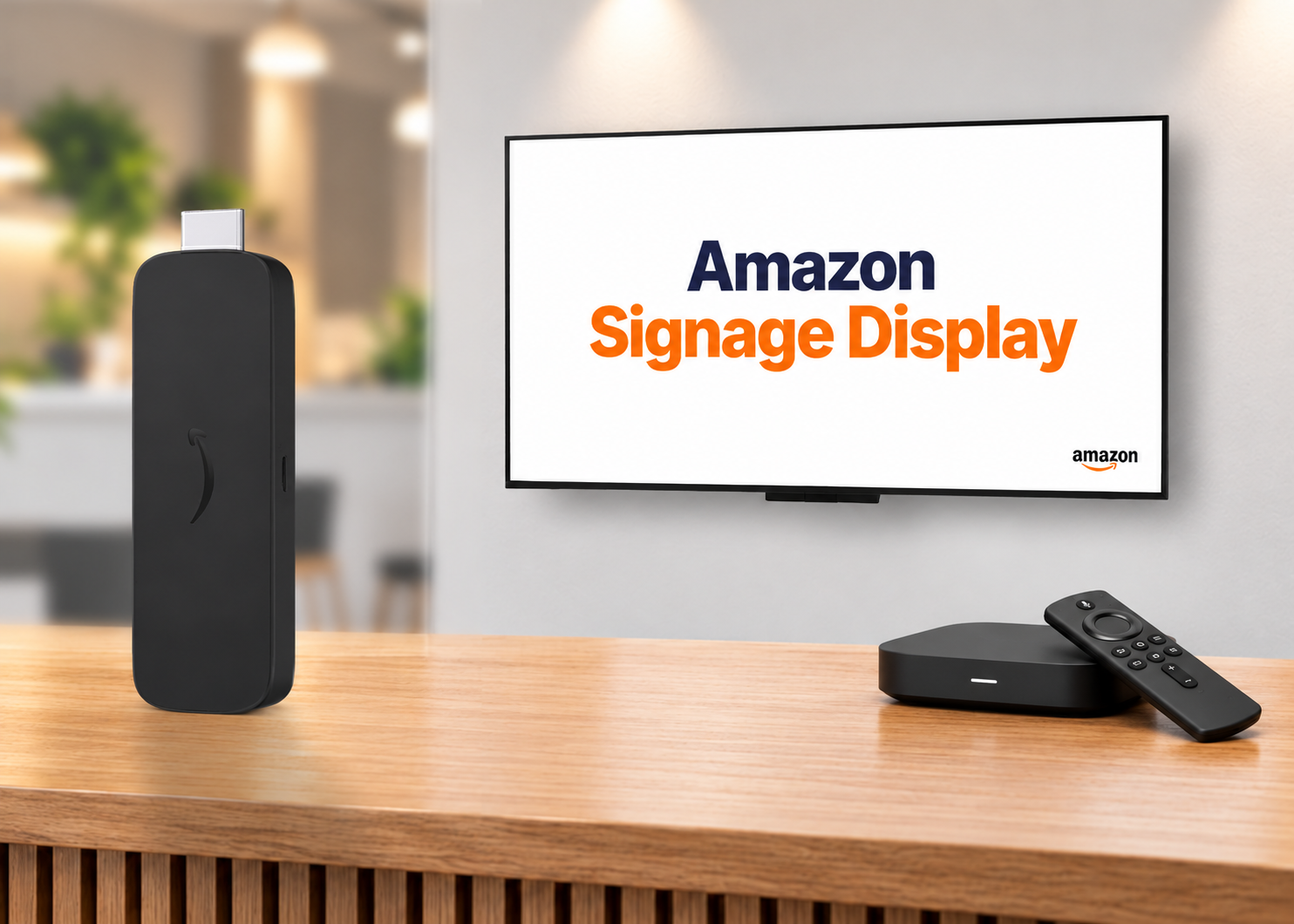
Decoding digital signage hardware–SoC display, specialized player, or purpose-built stick
The media player drives everything in a digital signage deployment. Here’s how the three main hardware categories compare and a framework for choosing the right one.
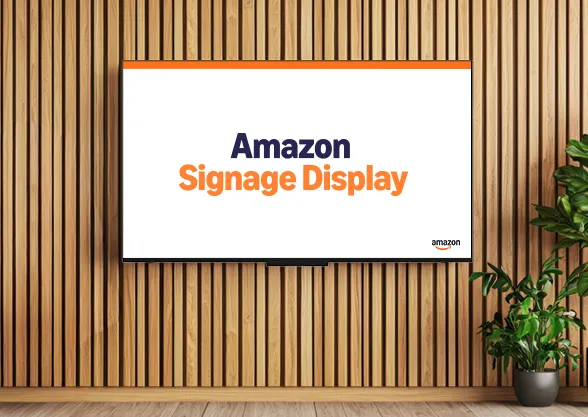
Digital signage made even simpler—introducing the Amazon Signage Display
Meet the Amazon Signage Display, a 55" 4K display with a built-in SoC media player, Ethernet, and Miracast. Same portal, app, and CMS support as the Amazon Signage Stick.
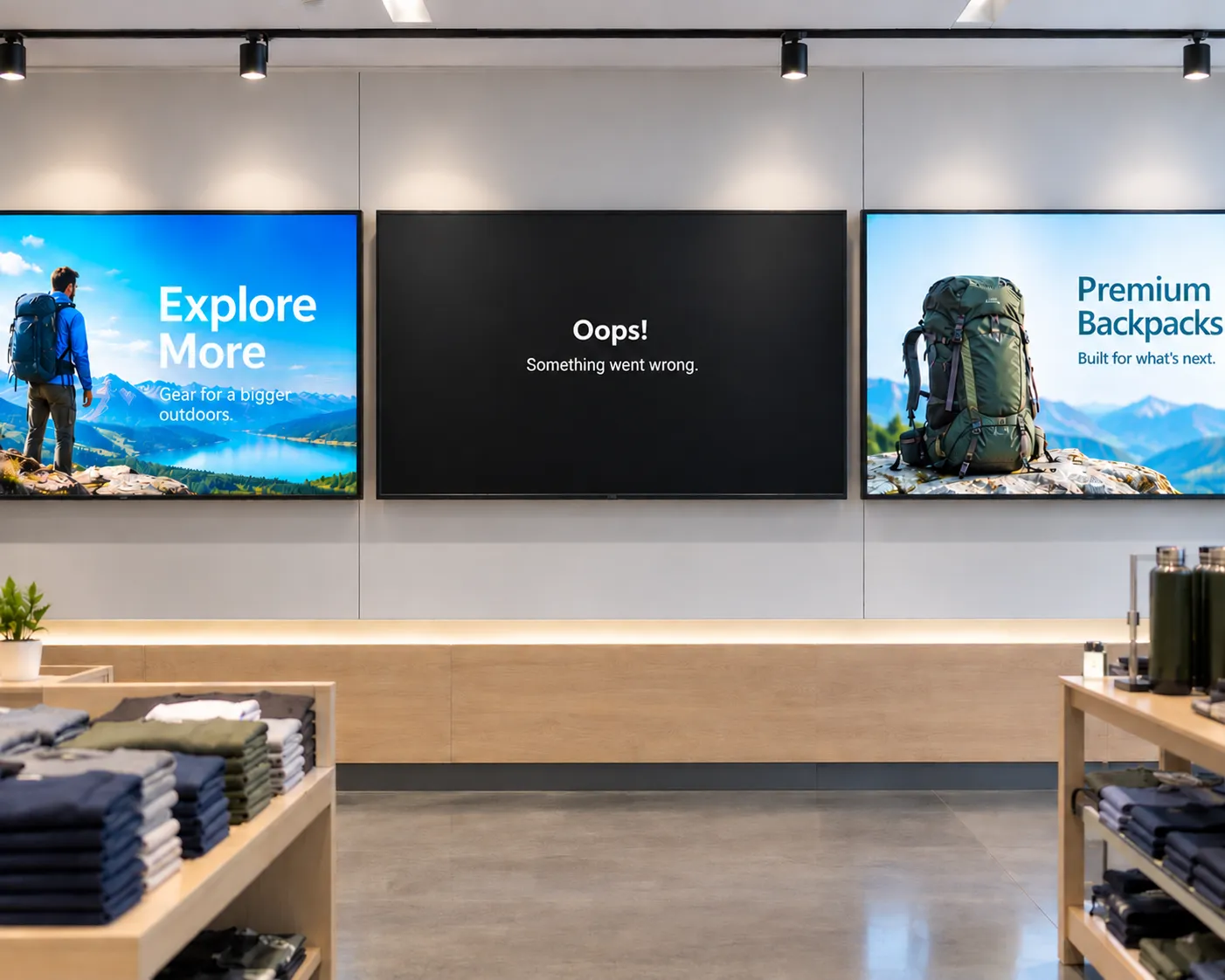
The hidden cost of "cheap" digital signage
From single-location businesses to enterprise fleets, cheap media players often cost more to operate than they save upfront. Here's what to factor in before you buy.