
The biggest myth about leveraging AI for digital signage
Many retailers struggle with leveraging AI for hyper-personalized digital signage that drives engagement and conversion. Learn how we shared a new path forward at the National Retail Federation conference.

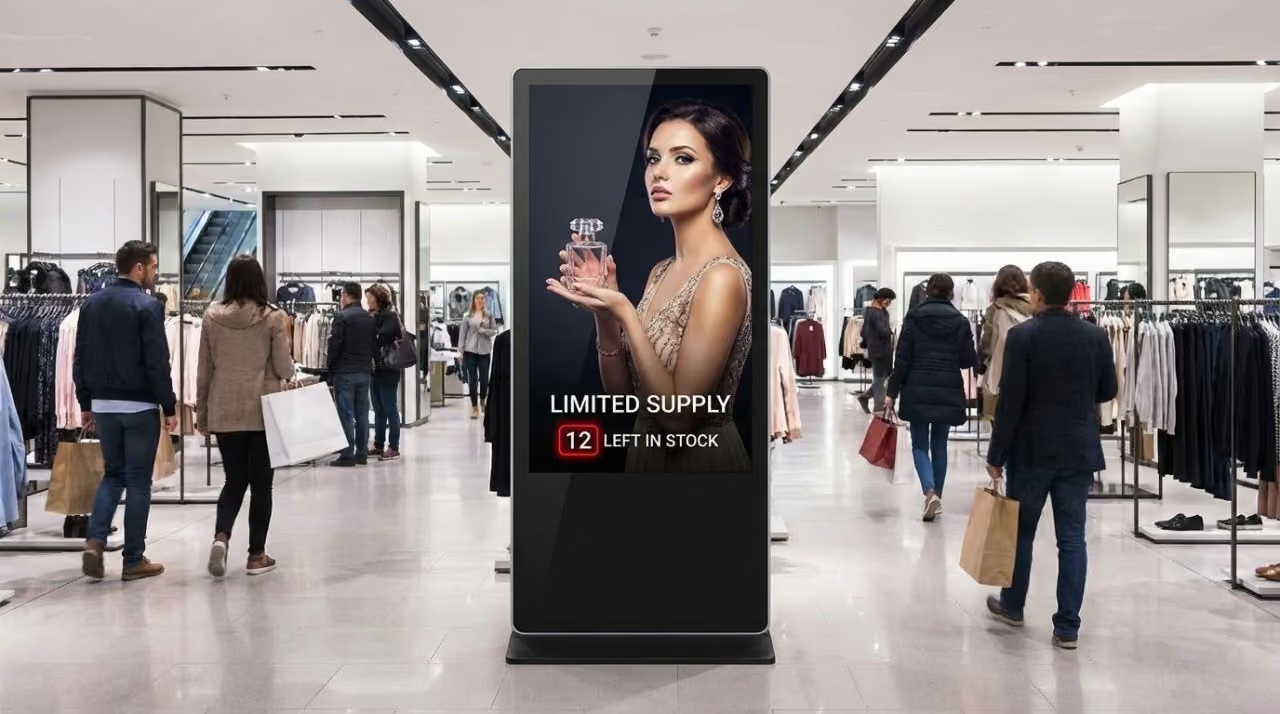
Many “AI +digital signage in retail” conversations still orbit the same center of gravity: more personalization, dynamic content generation, and edge-based processing power to affordably run the latest AI models. But the operators scaling digital signage from dozens of screens to thousands know the bottleneck isn’t creativity—it’s unit economics and operational friction. In this blog, I’ll discuss the myth associated with the need for complex, expensive edge hardware required to build AI into your digital signage. You’ll come away with clarity on how you can deliver hyper-personalized content that drives engagement and conversion with a cost-effective approach.
The hardware architecture associated with digital signage has dramatically changed over the past decade. Gone, for the most part, are the days when IT teams required windows-based or expensive specialized hardware devices as media players for digital signage. Cost-effective, android-based devices used as media players continues to proliferate – even in enterprise scale deployments. However, recently, as organizations start to evaluate how AI can be used to personalize digital signage content, the industry's guidance has been to again implement expensive media players to enable localized processing for AI models. So, IT and operations teams are faced with the same challenge – Hardware costs make it difficult to justify implementing AI-driven innovation for digital signage.
Here’s the counterintuitive takeaway: dynamic AI-driven content generation doesn’t require complex, GPU-heavy devices at the edge. In most retail deployments, the edge media player’s job is to reliably play content, not to run large models locally. That distinction changes the architecture, the cost model, and ultimately what scales.
The core idea: keep AI “heavy” in the cloud, keep playback “simple” at the edge
If you want dynamic content—localized offers, inventory-aware messaging, store-specific product launches—you should, in most cases, run the intelligence centrally (in the cloud) and push finalized content or lightweight instructions to affordable media players (for example, a device like Amazon Signage Stick) that focus on uptime, connectivity, and unattended operation.
This isn’t just an engineering preference. It’s the cleanest way to defend unit economics:
- Cost-to-activate per screen goes down when setup is simple and repeatable.
- Cost-to-operate per screen goes down when failures can be diagnosed and resolved remotely—without store IT and without “truck rolls.”
Working with innovators: a digital signage proof point from NRF
A useful reference point is the innovative solution Amazon Signage, AWS, Poppulo, and Idomoo collaborated on to showcase dynamic AI-driven in-store videos running on Amazon Signage Stick at the National Retail Federation (NRF) conference in January 2026. Based on customer input, our goal was to build a solution and associated architecture that could cost-effectively generate content dynamically using cloud services and publish it to in-store screens – without the need for complex edge hardware.
In our solution, Idomoo’s enterprise-grade video platform, leveraged AWS Bedrock models to dynamically generate content based on local in-store prompts (weather or personal information shared by in-store customers). Poppulo’s content management system then distributes the AI-generated content to affordable Amazon Signage Sticks to stream onto in-store displays.
That’s where the industry is headed: innovation in content generation + practical delivery into existing signage platforms, rather than rebuilding every endpoint into an AI powerhouse, which is more complex and eventually more expensive.
“Right-sized AI for digital signage”: pick the model that fits the task
One reason cloud-first works - you can optimize the creation costs by picking “just-right” models for each task.
With AWS Amazon Bedrock, you can choose from multiple foundation models via a single managed service, which makes it practical to route different jobs to different model classes (e.g., smaller/faster for structured copy variations; more capable models for complex reasoning or brand-safe rewriting).
Cost-wise, Bedrock pricing is fundamentally “pay for inference,” and it supports options like on-demand usage and batch modes that can be more cost-efficient for large volumes.
In retail signage, the winning architecture isn’t “always the biggest model.” It’s a pipeline that:
- constrains the problem (template + guardrails),
- uses the lowest cost model that meets quality,
- reserves heavier models for exceptions.
That’s how you scale dynamic content economically.
The TCO/operational drag of edge-based digital signage architecture shows up fast
It’s tempting to think: “Run models locally and avoid cloud inference costs.” In practice, local inference shifts costs, it doesn’t erase them. You still pay for:
- Post-training for the edge model
- Control + dataplane complexity for orchestration
- More expensive edge hardware (and refresh cycles)
- Distributed/edge power and cooling
- Maintenance/replacements
- Deployment complexity (more configuration states, more failure modes)
Recent discussions on edge vs. cloud AI economics emphasize building a full TCO (Total Cost Ownership) model—not just comparing the monthly cloud bill to a one-time device purchase.
And in retail, complexity has a direct tax: a more complex setup means higher operational cost. Every additional step and device requirement expands the surface area for store-by-store variance and escalations.
Operator translation: If you need a specialized on-site workflow to keep the model healthy, you’ve turned “AI” into an IT program. That breaks the scale.
Unit economics unlock the ability to use AI in digital signage
Once implementation, content creation, and distribution costs drop, organizations can begin implementing AI innovation in digital signage at scale. Since NRF, we have started collaborating with retailers who are focused on moving away from “one message for everyone” to testing what works locally—not as a marketing luxury, but as an operating habit.
AI allows retailers to rapidly A/B test personalized in-store content and ultimately enables retailers to move faster in determining what drives growth. The point is that AI generated personalized content + low-friction operations makes continuous experimentation feasible. That’s how in-store digital signage can become a learning system—not just a broadcast channel.
The next wave of value in retail signage AI won’t come from turning every endpoint into a high-end edge computer.
It will come from:
- cloud-based intelligence that minimizes creation cost (right model for the job),
- simple, reliable edge playback on affordable devices,
- guardrails that keep content useful and safe,
- and an operating model that reduces setup complexity and ticket load.
That’s what turns AI from hype into a tool that can operationally scale.
Resources
The hidden cost of "cheap" digital signage
From single-location businesses to enterprise fleets, cheap media players often cost more to operate than they save upfront. Here's what to factor in before you buy.

How smart hardware choices keep digital signage projects moving forward
Discover how IT teams are avoiding costly signage delays by pairing the right CMS with purpose-built media players—without ripping and replacing existing displays
Whether you deploy signage or buy it: simplified digital signage made reliable and scalable
Learn how Carousel, DataVisual, and Amazon Signage deliver simplified, scalable digital signage solutions that reduce complexity and operating costs for both resellers and end customers.